

Posted by: Eye Specialists of Mid Florida in Blog

By: William Corkins, O.D.
June is Cataract Awareness Month – it is important to understand what a “ripe cataract” is. Throughout my career, I have heard this statement from my patients, which I tell them is not true. The first thing I want patients to know is that we all develop cataracts. If we look inside the eye, we have a lens that is connected to muscles. When the muscles contract, the lens bends. This bending motion enables us to focus on objects as they get closer to our nose.
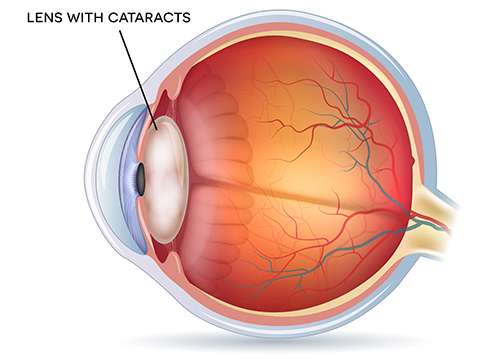
As we age, two things happen to our lens. The lens grows larger, and it gets cloudy. If I examine the lens of a baby, it is crystal clear and small, so when the muscles contract, the lens bends easily to focus on near objects. If I examine the lens when the child is 10 years old, the lens has grown larger, and it has become cloudier. At 20 years old, it is larger and cloudier. At 30, 40, 50, 60, 70, 80, 90, 100 years old, the lens gets larger and cloudier. Around 40-something, the lens gets big enough to the point where the muscles that move the lens cannot bend the lens to focus on near objects. This is when you will see people in their 40s tromboning back and forth to try to focus on close objects. This is when bifocals or reading glasses first start. Not only does the lens get bigger, it also gets cloudy to the point that I am saying you have the start of cataracts. Did the cataract just start at 46 or 47 years old? No, it starts at birth. This happens to everyone, like grey hair.
Once you tell a patient they have a cataract, they immediately want to know if they need surgery. We start to think about surgery whenever the glasses cannot correct the blur, or you are experiencing glare at night with the best glasses correction. The analogy I make is that if you drive your car with a dirty windshield and drive away from the sun, you can see through the windshield without any problem. If you turn the car around and drive towards the sun, you say to yourself, I need to clean the windshield. I cannot see. The dirt on the windshield causes the light to scatter. The scattering of the light causes the glare. Clean the dirt off the windshield, no more scattering, no more glare, you can see through the windshield. The cloudy lens/cataract is like the dirt on the windshield. My biggest complainer is a truck driver. He or she drives day and night, rain and snow, eight hours a day, five plus days a week. They will complain a lot louder compared to someone who is retired and goes home before it becomes dark. Ultimately, the person who decides to do cataract surgery is you. Not the doctor.
Cataracts are not like tomatoes; they do not have to get ripe. It used to be that they would not do cataract surgery unless your best correct visual acuity was 20/50 or worse using the Snellen chart (the big E chart). I suspect some doctors might say the cataract is not ripe enough, meaning insurance will not pay for cataract surgery because your visual acuity was better than 20/50. We found that using this method does not reflect the patient’s quality of life. I can have a patient who sees 20/20 on the Snellen chart, but under glare conditions, their visual acuity drops to 20/80 or worse because of cataracts. Glare testing more accurately reflects the patient’s quality of life. So, if your new glasses prescription does not get rid of blur or you still are experiencing glare, especially at night, then you must speak up. Cataract surgery is the next step. If you are debating if your cataracts are “ripe” enough or not, call us at 800-282-3937 to schedule a cataract evaluation.
Dr. William Corkins is a board-certified optometrist who sees patients at the Lakeland-Harden location for Eye Specialists of Mid-Florida. He is accepting new patients at this time.